
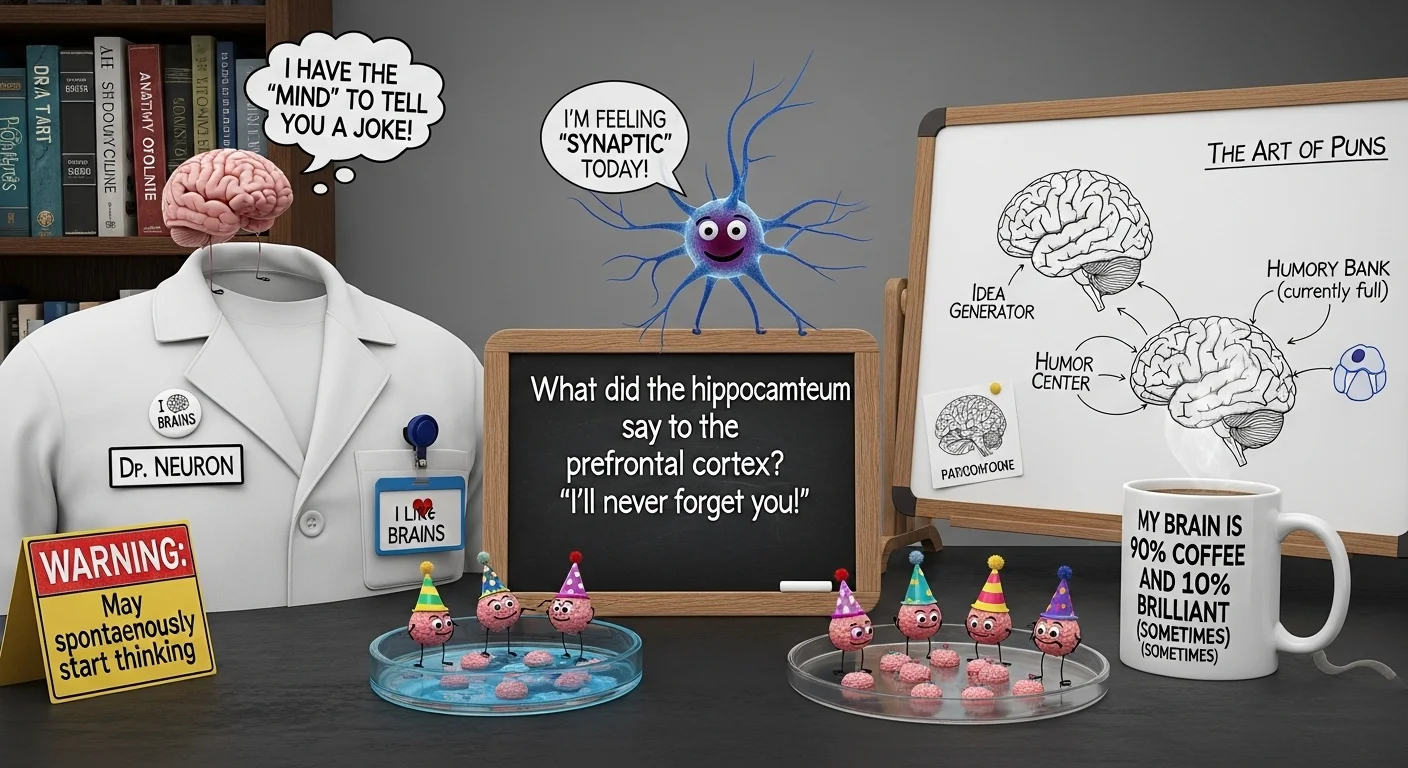
Neuroscience Jokes One Liners
I told my brain a joke, but it needed time to process.
Neuroscientists don’t argue—they synapse to conclusions.
My neurons are fired up today.
I tried to relax, but my brain had other cortex in mind.
Neuroscience really gets on my nerves.
I’ve got a lot on my mind—mostly gray matter.
That idea sparked a neural connection.
My brain loves networking—it’s well connected.
Don’t mind me, I’m just wired differently.
I lost my train of thought—must be a signal delay.
Neuroscience Jokes in English
Why did the neuron bring a suitcase? It was ready to travel down the axon.
Why are brains so confident? They have a lot of nerve.
What do you call a smart synapse? A bright connection.
Why did the brain go to school? To get more knowledge cells.
What’s a neuron’s favorite game? Mindcraft.
Why did the scientist study the brain? It was on their mind.
What do brains eat for breakfast? Cere-al.
Why was the cortex calm? It kept things under control.
What’s a neuron’s favorite exercise? Brain-storming.
Why did the brain blush? It was thinking too hard.
Neuroscience Jokes for Adults
My brain has too many tabs open—classic cognitive overload.
I told my amygdala to chill, but it overreacted.
My hippocampus stores memories better than my phone.
I need dopamine, not drama.
My neurons fire faster than my WiFi.
I tried mindfulness, but my prefrontal cortex had a meeting.
My stress response has great connectivity.
Brain fog is just low bandwidth thinking.
I overthink because my synapses love cardio.
My brain runs on coffee and questionable decisions.
Funniest Neuroscience Jokes
Why did the neuron break up? There was no connection.
I asked my brain for a break—it said, “I’m already working overtime.”
Why did the synapse apply for a job? It wanted to make connections.
My brain tried stand-up comedy—it had great delivery.
Why don’t neurons gossip? They don’t want crossed wires.
I took my brain to the gym—it worked on its neural networks.
Why did the brain get promoted? It had outstanding cortex.
My thoughts travel so fast—they must be on the express axon.
Why was the brain a good detective? It always used its head.
My neuron started singing—it hit all the right impulses.
Brain Jokes
Why did the brain go on vacation? It needed to unwind.
My brain is like a browser—too many tabs open.
Why was the brain popular? It had good chemistry.
My brain loves puzzles—it likes to think outside the skull.
Why did the brain join the band? It had great rhythm.
My brain forgot what it was saying—classic short circuit.
Why did the brain ace the test? It had the nerve.
My brain throws sparks of genius.
Why was the brain cool? It stayed sharp.
My brain deserves a standing ovation.
Brain Jokes One Liners
I changed my mind—my brain updated.
My brain is wired for success.
Don’t mind me, I’m thinking.
Brain power is real power.
I brain-stormed and it rained ideas.
My headspace is fully booked.
I gave my brain a raise—it earned it.
Mind over matter… mostly mind.
My brain loves deep thoughts.
I think, therefore I pun.
Short Neurologist Jokes
Why did the neurologist stay calm? They had nerves of steel.
The neurologist’s favorite band? The Cranial Nerves.
Why was the neurologist funny? Sharp wit, sharp mind.
The neurologist solved problems head-on.
Why did the neurologist smile? Good brain day.
The neurologist loves connections.
Why did the neurologist bring a map? To find the right pathway.
The neurologist always keeps their head in the game.
Why was the neurologist confident? They knew their cortex.
The neurologist’s advice? Use your head.
Best Neuroscience Jokes
Neuroscience proves it’s all in your head.
My neurons throw the best signal parties.
A balanced brain is a happy brain.
Why did the brain cross the road? To expand its horizons.
My synapses never miss a beat.
The brain is the ultimate multitasker.
I told my neuron to focus—it fired back.
Good vibes start in the mind.
My brain loves complex relationships—it’s highly connected.
Keep calm and think on.
Brain Cell Banter
Why did the neuron bring a ladder? It wanted to reach higher potentials.
A glial cell walked into a bar—nobody noticed, but it still supported everyone.
The neuron refused to gossip because it didn’t want to spread signals unnecessarily.
Synapses rarely get lonely; they’re always making connections.
The axon went on a diet—it wanted to reduce its resistance.
Two neurons argued, but eventually they fired together.
The dendrite loved parties—it was always branching out.
A neuron tried yoga, but couldn’t relax; too much tension.
The glial cell opened a clinic because it specialized in supportive care.
The brain cell got promoted; it finally showed potential.
Cortex Comedy
The cortex applied for a job; it said it had layers of experience.
When asked to simplify things, the cortex said, “That’s beneath me.”
The prefrontal cortex planned a vacation six months in advance—as usual.
The visual cortex refused to debate; it only dealt with facts it could see.
The auditory cortex interrupted because it heard everything first.
The somatosensory cortex insisted on hands-on training.
The motor cortex wanted to dance; it couldn’t help but move.
The olfactory cortex disliked mysteries; they never passed the sniff test.
The gustatory cortex gave spicy feedback.
The cortex wrote a memoir called “Gray Matters.”
Synapse Silliness
The synapse threw a party and invited only close friends.
The neurotransmitter overshared—it couldn’t control its release.
A neuron lost its job due to poor transmission.
Electrical synapses love speed; no time for small talk.
Chemical synapses prefer drama; they love a good release event.
The receptor complained; the ligand kept sticking around.
The vesicle insisted it carried essential cargo.
The synaptic cleft held a meeting but everyone stayed distant.
The neurotransmitter apologized for the delay; traffic at the terminal was heavy.
The synapse loved compliments—it thrived on positive feedback.
Brain Anatomy Zingers
The hippocampus joined a book club—it never forgets.
The amygdala hates surprises; they trigger emotional reactions.
The cerebellum offered balance in every argument.
The medulla doesn’t panic—it handles pressure daily.
The thalamus ran a mailroom, sorting messages for the brain.
The hypothalamus scheduled snack times religiously.
The pituitary gland bragged that it ran the whole hormonal show.
The corpus callosum hosted a bridging seminar.
The pons mediated conflicts between upper and lower management.
The midbrain staged a dramatic rerouting.
Neuron Lifestyle Puns
The neuron joined a gym to strengthen its connections.
It also joined a meditation group to calm its firing rate.
The axon subscribed to a fiber-rich routine.
The dendrite bought growth serum—purely for branching.
The neuron tried minimalism: fewer signals, more peace.
It started journaling to track its potentials.
The glial cells created a wellness spa.
Neurotransmitters joined a delivery club for faster shipping.
The neuron tried therapy for identity issues—it felt too polarized.
The synapse enrolled in networking classes.
Brain Science Wordplay
When the brain won an award, it accepted with deep gratitude.
The neuron had a bright idea—literally.
The cortex made a pun so complex it required interpretation.
The limbic system cried at movies; it’s wired that way.
The axon tried to be positive but kept going negative.
The neuron overslept and missed its action potential.
The brain filed a complaint—it needed more space.
The synapse ran late; it faced a delay in transmission.
The cerebellum hosted a coordination workshop.
The hippocampus published a memory lane travel guide.
Cognitive Giggles
Cognition held a debate but forgot the conclusion.
The decision-making center couldn’t decide on lunch.
Attention got distracted halfway through the meeting.
Memory struggled to recall why it walked into the room.
Learning tried something new just for the experience.
Problem-solving loved puzzles more than people.
Creativity painted outside every boundary.
Reasoning tried to stay logical, even in chaos.
Perception misread the situation again.
Imagination created scenarios nobody asked for.
Mind-Body Mashups
The brain scheduled a spa day for the muscles.
The body asked the brain for directions and still got confused.
The spine supported everyone like a true backbone.
The hands complained—they always got the work.
The legs ran from responsibility.
The lungs took a deep breath before advice.
The heart wore its emotions openly.
The stomach protested unfair working conditions.
The skin wanted smoother interactions.
The muscles flexed for attention.
Neuro Humor for Teachers
A teacher told neurons to settle down—they were firing wildly.
The cortex asked for homework extensions.
The hippocampus graded based on memory.
The synapse asked for extra space between students.
Neurotransmitters submitted assignments late due to release delays.
The amygdala objected to pop quizzes.
The cerebellum tutored in coordination.
The axon refused group work—too much conduction.
Glial cells volunteered behind the scenes.
The neuron earned extra credit for positive feedback.
Neuro Humor for Students
Students said their brains needed more RAM.
The hippocampus begged for better study habits.
The amygdala panicked before exams.
The cortex overanalyzed every question.
Attention drifted during lectures.
Memory pulled an all-nighter.
Reasoning argued with the answer key.
Perception misread the instructions.
Learning took shortcuts.
Creativity decorated the notes.
Brain Lab Laughs
The microscope magnified problems unnecessarily.
The lab coat refused to blend in.
The petri dish hosted growth seminars.
The scalpel cut straight to the point.
The pipette delivered precise feedback.
The slide presented a clear perspective.
The sample tissue complained about exposure.
The centrifuge spun out of control.
The lab tech labeled everything, including feelings.
The gloves refused to get involved.
Neural Network Nonsense
The network bragged about staying connected.
The nodes formed a tight-knit group.
The signal flow refused to take shortcuts.
The layers added depth to the conversation.
The weights had too much influence.
The biases made unfair judgments.
The activation function needed time to warm up.
The output complained about pressure.
The model refused to overfit socially.
The algorithm promised to learn from mistakes.
Psychology-Inspired Puns
Freud blamed the id again.
Behaviorism demanded observable laughter.
Humanism offered unconditional positive humor.
Cognitivism wanted internal jokes explained.
The ego joined a confidence workshop.
The superego offered unsolicited advice.
Conditioning insisted on consistent punchlines.
Perception wanted clearer setups.
Emotion argued with logic.
Learning adapted after every punchline.
Brainy Relationship Jokes
Two neurons dated—they had great chemistry.
The synapse needed space; connections were overwhelming.
The neurotransmitter sent mixed signals.
The cortex overthought everything.
The amygdala took things too personally.
Memory refused to let go.
The cerebellum tried to balance the relationship.
The glial cells played supportive roles.
The axon preferred long-distance communication.
The dendrite wanted more branches in the relationship.
Memory Lane Laughs
Memory promised to recall things later.
Short-term memory forgot to RSVP.
Long-term memory kept old grudges.
Working memory tried multitasking and failed.
The hippocampus documented the event.
The brain took a stroll down memory lane.
Retrieval cues nudged for attention.
Encoding asked for better clarity.
Storage complained it was full.
Recall showed up late.
Smart-Science Puns
The researcher analyzed every joke.
Data walked in with confidence intervals.
The hypothesis expected a positive response.
The experiment tested the limits of humor.
Variables refused to stay consistent.
The conclusion wrapped things neatly.
The sample size wanted more friends.
The control group stayed calm.
The results were statistically amusing.
The graph showed a rising curve of laughter.
IQ-Themed Wit
Intelligence took an online test and doubted the results.
Logic solved problems before they existed.
Creativity refused to stay linear.
Wisdom avoided unnecessary arguments.
Knowledge bragged about experience.
Curiosity asked too many questions.
Analysis broke everything down.
Strategy planned ten steps ahead.
Memory chimed in with random facts.
Humor tied it all together.
Academic Puns
The professor assigned too many thoughts.
The lecture hall echoed with confusion.
The syllabus made bold promises.
The textbook weighed more than hope.
The exam paper judged silently.
The research paper demanded more sources.
The lab manual refused to simplify.
The thesis stayed unfinished.
The notes turned cryptic overnight.
The homework asked for lifelong commitment.
Scientific Storylines
The experiment began with high potential.
The control group stayed composed.
The variables staged a rebellion.
The researchers pursued clarity.
The data dragged its feet.
The graphs illustrated drama.
The analysis stitched everything together.
The review panel asked tough questions.
The conclusion tied loose ends.
The report sought peer approval.
Brain-Powered Punchlines
The brain held a brainstorm and got soaked.
The neurons exchanged sparks.
The cortex ran the meeting.
The amygdala protested deadlines.
The cerebellum coordinated the snacks.
The thalamus distributed invitations.
The hippocampus planned reunions.
The hypothalamus managed the thermostat.
The synapses networked efficiently.
The brain wrapped up with positive potential.
